Real-Time Sign Language Translation Mobile Application
On-device AI-powered mobile app that translates sign language gestures into text and text into sign language guidance—bridging communication gaps for the deaf community.
Sign Bridge is a mobile application designed to facilitate real-time communication between deaf and hearing individuals through advanced computer vision and machine learning technologies.
Develop a mobile application that enables seamless, real-time translation between sign language gestures and text using on-device machine learning models.
Deaf and hard-of-hearing individuals, their families, educators, and anyone who needs to communicate across the hearing-deaf divide.
Flutter for cross-platform UI, Kotlin for native Android processing, MediaPipe for hand tracking, and TensorFlow Lite for gesture classification.
Deaf individuals worldwide
Access to sign language interpreters
Average hourly interpreter cost
Deaf individuals face daily struggles in healthcare, education, employment, and social interactions due to communication gaps.
Severe global shortage of certified sign language interpreters makes professional services inaccessible and expensive.
Current mobile solutions lack real-time capability, require internet connectivity, or provide incomplete sign language support.
Cloud-based translation systems expose sensitive conversations to external servers, raising privacy and security issues.
Sign Bridge addresses these challenges through an innovative mobile-first approach with dual-direction translation capabilities.
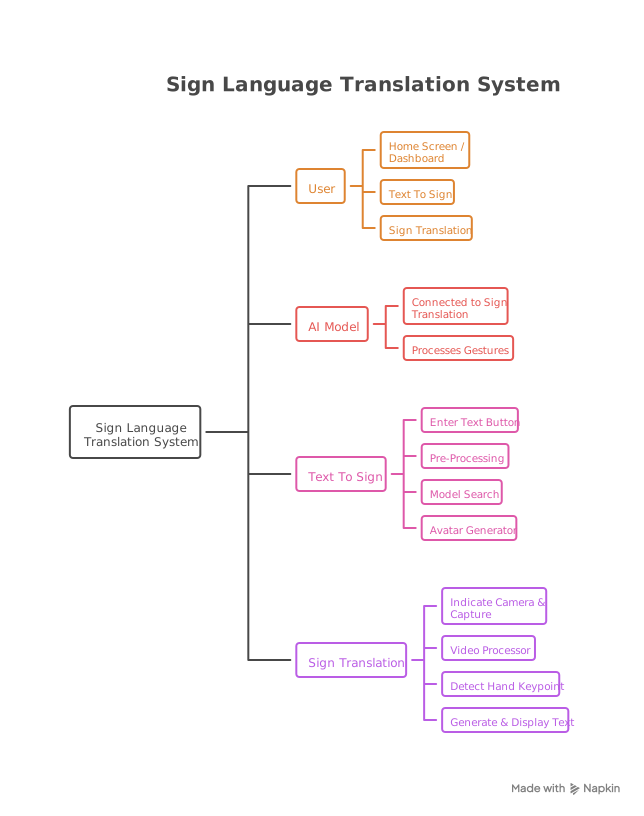
User performs sign gestures in front of the device camera at 30 FPS
MediaPipe detects both hands simultaneously with 42 landmark points
System collects 30 frames (1 second) of landmark data for temporal analysis
TFLite model identifies the sign from 250+ vocabulary with confidence scores
Detected signs accumulate into complete sentences with 1.5s cooldown timing
Key Features: Dual-hand support enables complex bi-manual signs • On-device processing ensures privacy • No internet required • Real-time feedback with confidence indicators
User types or speaks a phrase they want to learn in sign language
NLP breaks down the sentence into individual sign-mappable words
System matches each word to corresponding sign gesture from the vocabulary
App displays step-by-step visual instructions for performing each sign
User practices signs with real-time feedback and validation
Key Features: Bidirectional learning tool • Visual sign demonstrations • Step-by-step guidance • Practice mode with feedback • Educational for hearing users
Cross-Platform Framework
Flutter provides beautiful, responsive UI with single codebase for Android/iOS, while Kotlin handles native Android processing via MethodChannel for optimal performance.
Hand Landmark Detection
Google's MediaPipe HandLandmarker provides real-time detection of 21 landmark points per hand with high accuracy (~30ms processing time) running entirely on-device.
Machine Learning
Lightweight TFLite models classify sign gestures from landmark sequences. Models are quantized for mobile deployment with 250+ sign vocabulary and 85-92% accuracy.
Camera Framework
Android CameraX API provides consistent camera access across devices with optimized frame processing pipeline for real-time computer vision applications.
Flutter UI layer handles user interactions, displays results, and manages application state with clean, accessible interface design.
MethodChannel facilitates bidirectional communication between Flutter (Dart) and native Android code (Kotlin) for performance-critical operations.
Native Kotlin layer manages camera streams, invokes MediaPipe models, runs TFLite inference, and implements sequence buffering logic.
Initializes device camera, configures optimal settings for gesture detection, and streams frames at 30 FPS to the processing pipeline.
Uses MediaPipe to detect and track both hands simultaneously, extracting 21 normalized landmark coordinates per hand with confidence scores.
Maintains a sliding window buffer of 30 consecutive frames, creating temporal sequences for classification and managing data flow.
TFLite model performs inference on buffered sequences, outputting probability distributions across 250+ sign vocabulary with confidence thresholds.
Accumulates detected signs into coherent sentences with intelligent cooldown timing (1.5s) to prevent duplicate detections and enable natural pacing.
Parses text input, maps words to sign vocabulary, and generates visual guidance for users to learn and practice corresponding sign gestures.
A dedicated team working under expert supervision to deliver this innovative solution.
Flutter Developer
Focuses on Flutter UI development, state management, and overall application experience.
ML Engineer & Android Developer
Handles machine learning model training, TensorFlow Lite integration, and native Android processing with Kotlin.
Computer Vision & UI/UX Designer
Implements MediaPipe integration, designs user interface, and ensures accessibility compliance for deaf users.
Preview the proposal below or download the full document.